
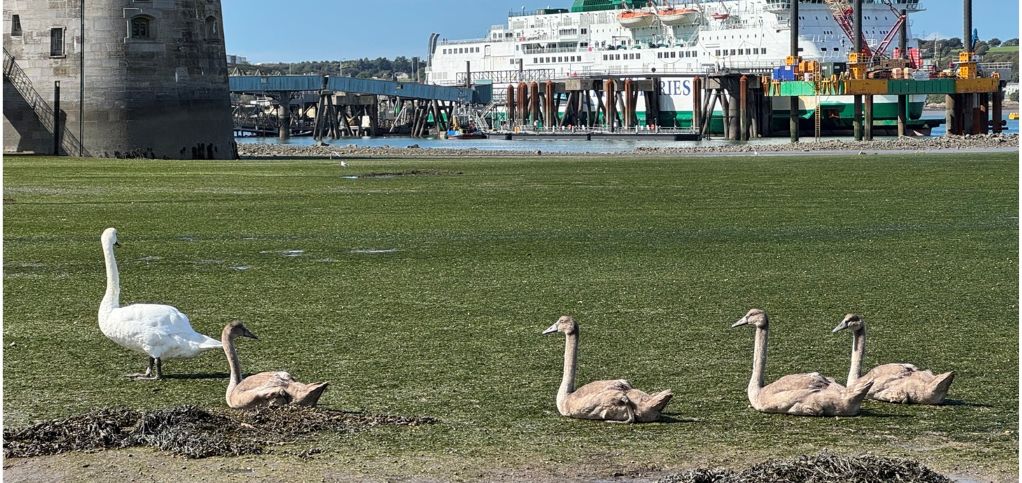
Swans rest on an exposed coastal meadow beside a busy ferry terminal, bringing living ecosystems and built infrastructure into the same frame. The image accompanies the argument that marine ecosystems are essential infrastructure supporting biodiversity, food security and societal resilience in an era of ocean polycrisis. (Photograph: Richard K F Unsworth)
Researchers are calling for lasting investment in healthy seas to support food security, protect coastlines and strengthen economic resilience.
They say governments should give the protection and recovery of marine ecosystems the same long-term commitment they give to other essential infrastructure.
In a new paper in the journal Nexus, researchers from Swansea University, Project Seagrass and King Abdullah University of Science and Technology (KAUST) warn that damage to marine life threatens the food supplies, coastal protection and livelihoods that healthy seas support.
They call for ocean recovery to become part of long-term government planning, backed by investment that lasts beyond elections and individual funding programmes.
Lead author Dr Richard Unsworth, Associate Professor at Swansea University and Chief Scientific Officer at Project Seagrass, said: “We plan roads and energy networks for decades. We need that same long-term thinking for the living systems that support our food, coastlines and climate.
“When marine ecosystems deteriorate, the consequences reach well beyond wildlife. Protecting them is an investment in the security and wellbeing of communities.”
Drawing on existing research, the paper examines how environmental decline, political instability and economic pressures interact. Warming seas and other pressures are damaging marine ecosystems, while weakening international cooperation and uncertainty over funding make sustained recovery harder to achieve.
For an island nation such as the UK, the argument connects the health of marine habitats with decisions about fisheries, coastal protection and public spending. Seagrass meadows, saltmarshes and other coastal ecosystems support benefits that the authors say must be recognised in how governments plan and invest. The researchers also call for a stronger focus on whether conservation is delivering recovery. Targets for the area protected or restored remain useful but must be accompanied by evidence that ecosystems are becoming healthier.
Dr Unsworth said: “We cannot judge success simply by drawing a boundary on a map or counting how many hectares we have planted. We need to know whether marine life is recovering, whether habitats are supporting fisheries and whether coastal communities are seeing the benefits.
“That means investing in monitoring and being open about what is working and what needs to change.”
The authors want sustained public and private investment, restoration focused on places where recovery is scientifically realistic, and coastal communities involved in shaping decisions from the outset.
The paper highlights seagrass ocean rescue in West Wales as an example of restoration developed with community involvement. The researchers argue that conservation is more likely to endure when local people help shape it and share in its benefits.
They stress that funding must support the time needed for ecosystems to recover, including continued management and monitoring after the initial intervention.
Dr Unsworth added: “Recovery takes time. A change of government or the end of a funding programme should not mean abandoning years of work.
“We depend on healthy seas every day. Our commitment to their future needs to reflect that.”
Read the paper: Marine ecosystems are essential infrastructure in an era of ocean polycrisis, by Richard K.F. Unsworth, Leanne Cullen-Unsworth, Benjamin L.H. Jones and Carlos M. Duarte.