
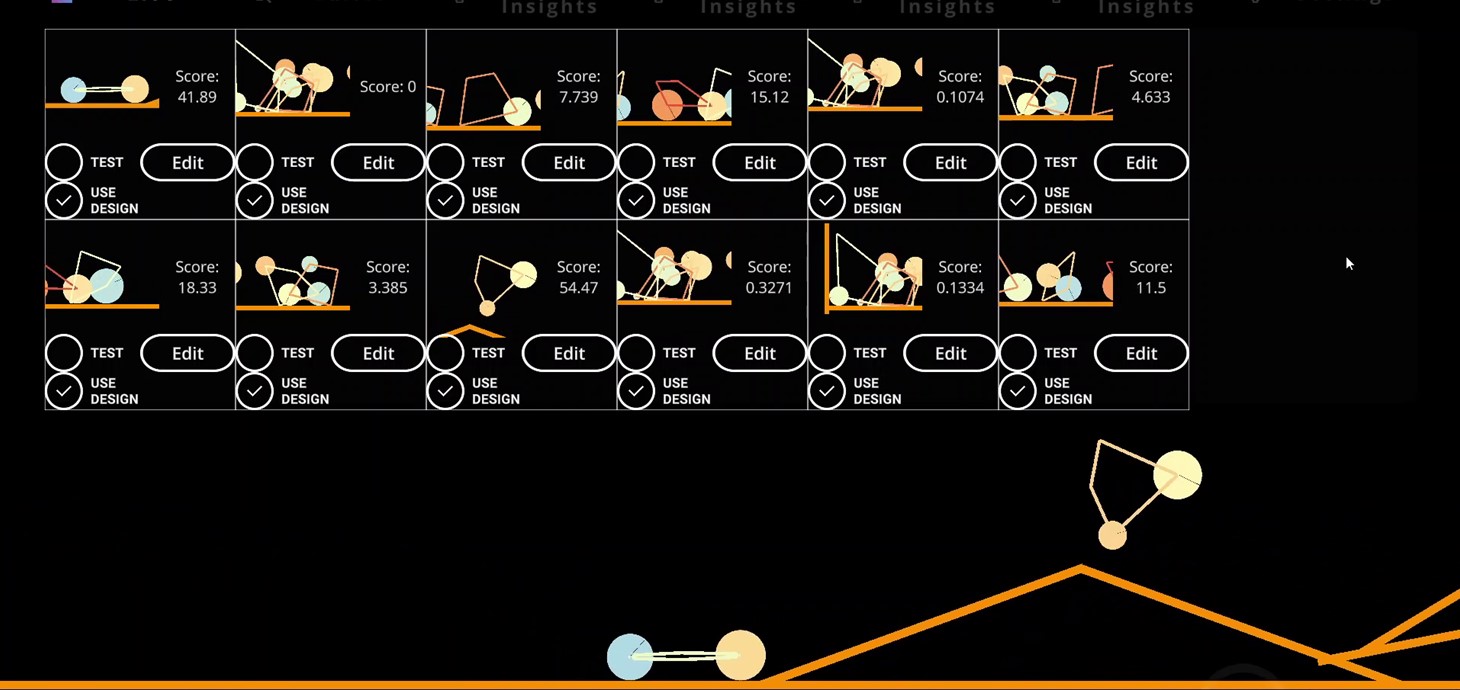
Study participants were tasked with designing a virtual car on the Genetic Car Designer Game.
Artificial intelligence (AI) is often seen as a tool to automate tasks and replace humans, but new research from Swansea University challenges this view, showing that AI can also act as a creative, engaging and inspiring partner.
A team from the University’s Computer Science Department has conducted one of the largest studies to date on how humans collaborate with AI during design tasks. More than 800 participants took part in an online experiment using an AI-powered system that supported users as they designed virtual cars.
Unlike many AI tools that optimise solutions behind the scenes, this system used a technique called MAP-Elites to generate diverse visual design galleries. These galleries included a wide range of potential car designs, including high-performing examples, unusual ideas and some deliberately imperfect ones.
Turing Fellow Dr Sean Walton, Associate Professor of Computer Science and lead author of the study, explained: “People often think of AI as something that speeds up tasks or improves efficiency, but our findings suggest something far more interesting. When people were shown AI-generated design suggestions, they spent more time on the task, produced better designs and felt more involved. It was not just about efficiency. It was about creativity and collaboration.”
A key insight from the study, published in the ACM journal Transactions on Interactive Intelligent Systems, is that traditional ways of evaluating AI design tools may be too narrow. Metrics such as how often users click or copy suggestions fail to capture the emotional, cognitive and behavioural dimensions of engagement. The Swansea team argues for more holistic evaluation methods that consider how AI systems influence how people feel, think and explore.
Dr Walton added: “Our study highlights the importance of diversity in AI output. Participants responded most positively to galleries that included a wide variety of ideas, including bad ones! These helped them move beyond their initial assumptions and explore a broader design space. This structured diversity prevented early fixation and encouraged creative risk-taking.
“As AI becomes increasingly embedded in creative fields, from engineering and architecture to music and game design, understanding how humans and intelligent systems work together is essential. As the technology evolves, the question is not only what AI can do but how it can help us think, create and collaborate more effectively.”
Read From Metrics to Meaning: Time to Rethink Evaluation in Human–AI Collaborative Design in full.
Learn more about Swansea University’s Computational Foundry.