View People & Planet's Assessment Methodology for Staff.
Swansea University has a dedicated Sustainability Team working towards the goals, ambitions and success of Swansea University and beyond to achieve significant, well-resourced and long-term success across environmental sustainability. The Sustainability Team has its own annual budget which funds the delivery of the Sustainability Strategy commitments.
The Sustainability Team is supported to deliver the Sustainability Strategy through an annual budget derived of internal and external funding (e.g. University, HEFCW, Welsh Government & the third sector). The budget changes on an annual basis and is usually between £500k – £1m. Annually, approximately £3m is invested in net zero projects including: Solar PV installation, Energy Efficiency projects and Building Management System infrastructure and software.
The University has a network of Environmental Coordinators. This network helps improve environmental performance across the University, and with the creation of the faculties, this network is looking to be expanded during 2024/25.
The Sustainability Committee at the University is co-chaired by Niamh Lamond, Registrar and COO, and Helen Griffiths, Pro-Vice-Chancellor for Research and Innovation. This Committee has direct responsibility for delivering our Sustainability Strategy, with representatives from Faculties and PSUs.
Sustainability Committee Terms of Reference
See our Get Involved webpage for more details on becoming an Environmental Coordinator and our Sustainability and Wellbeing (SWell) programme. Carbon literacy training is also available for all staff and students, with a new e-learning module now live online.
See the Policy and Strategy section for details of the Sustainability Committee and the Terms of Reference.
Guidance on minimising energy consumption from digital infrastructure
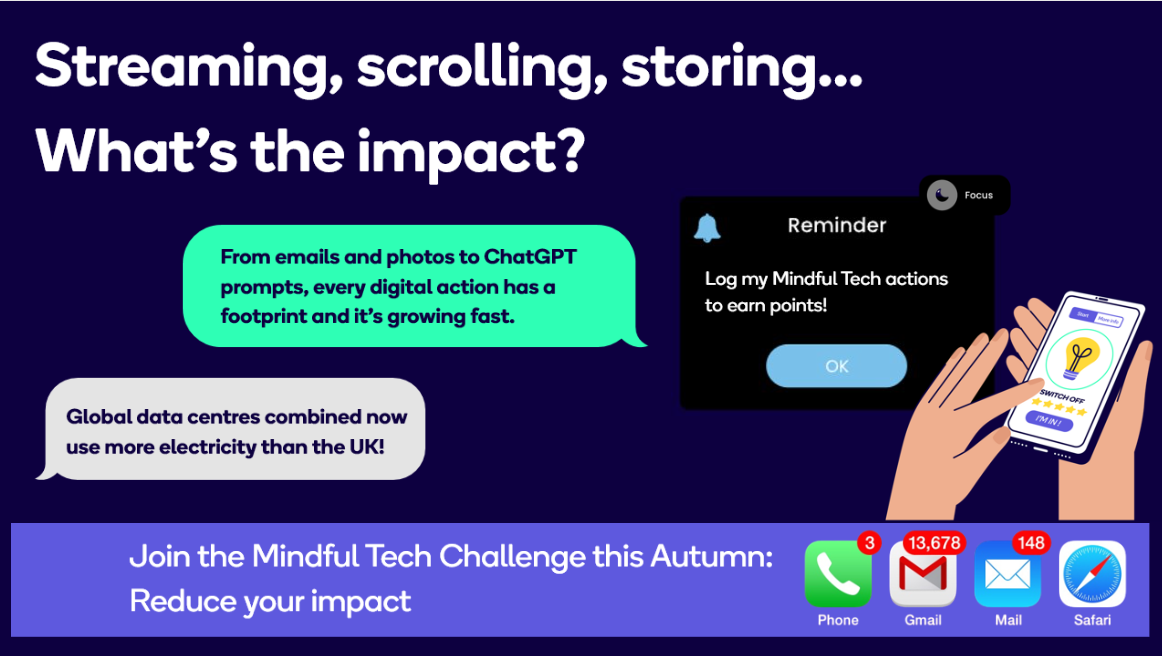
Between October and December 2025, we delivered the "Mindful Tech" campaign through our SWell app, focusing on the environmental impact of technology use, providing guidance on digital behaviours, and e‑waste. As part of the campaign:
- 1,270 actions were recorded
- Knowledge scores increased from an average of 6/10 to 8/10
- 97% of participants changed how they use digital tools to reduce their environmental impact
- 97% reported being more mindful about electronic care, recycling, and disposal
This demonstrates clear guidance and behaviour change relating to energy‑efficient digital practices.
Guidance on AI usage and the environmental implications of AI
As part of the Mindful Tech campaign, we offered dedicated e-learning [How AI and Data Are Affecting Our Planet] with guidance and content covering technology, AI and e-waste. Participant feedback included:
- 97% said the e-learning increased their knowledge about the environmental impact of technology, AI, and e‑waste.
- 100% agreed the e-learning was an effective way to learn.
- 100% said they would find similar e-learning valuable for other sustainability topics.
This provides strong evidence that staff and students received guidance on responsible AI use, including environmental implications and wider digital risks.
Sustainable / privacy-focused search engines
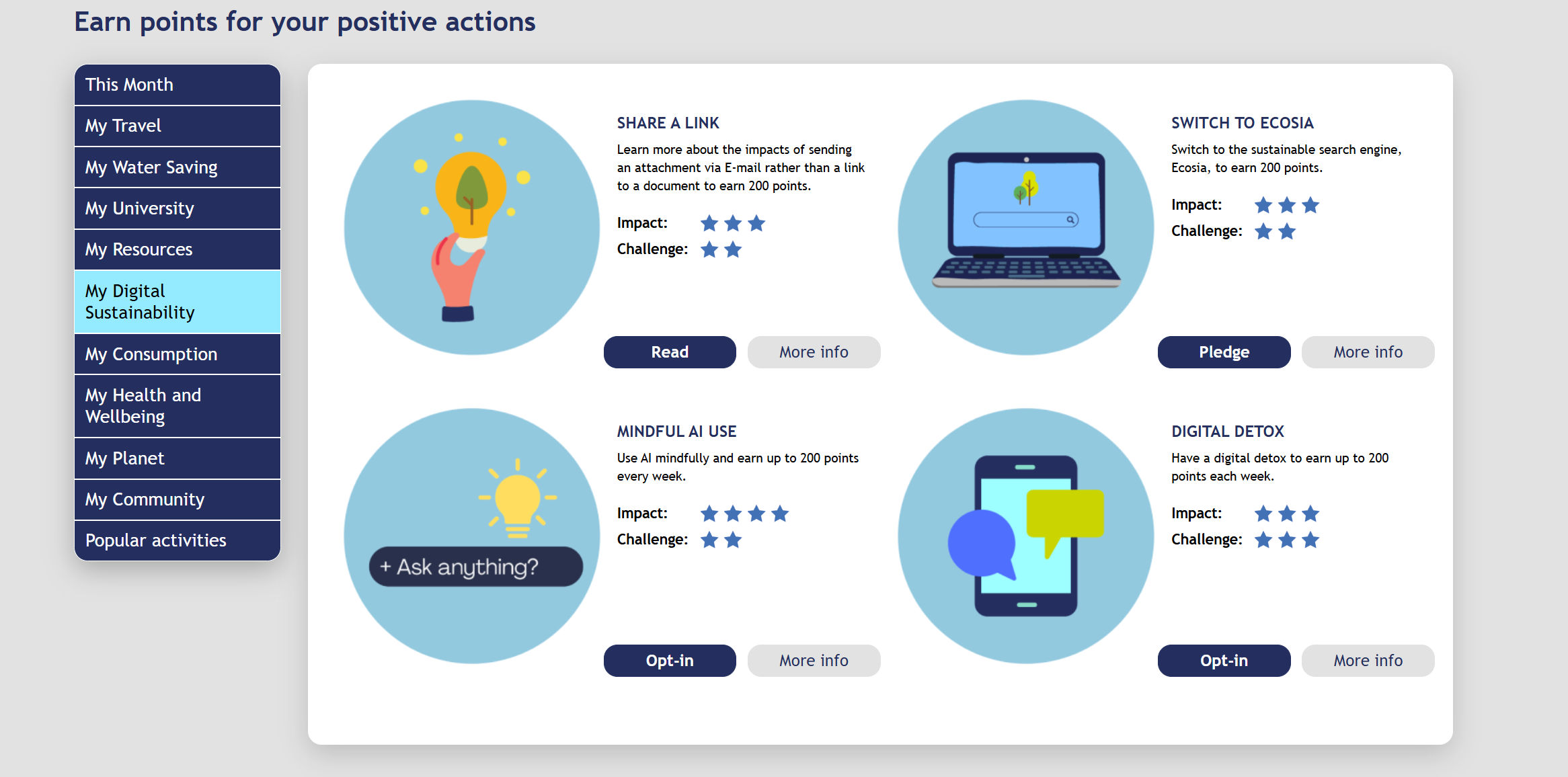
Through our SWell sustainability engagement app, staff and students can earn points for adopting greener, privacy-respecting search engines such as Ecosia. This action complements the University’s wider Mindful Tech campaign and digital sustainability e‑learning, providing measurable evidence of user engagement and supporting institutional moves towards more sustainable digital defaults for university managed devices and those in libraries and communal spaces.
How Swansea students brought Ecosia to campus.
SWell Newsletter - Digital Sustainability
Digital Sustainability on SWell
Our strategy, policy and procedures for minimising and managing e-waste
Swansea University has a documented policy and operational framework for minimising electronic waste (e‑waste) arising from IT hardware, printing processes, consumables and other electronic equipment. This commitment is embedded within the University's Sustainability Policy, Environmental Management System (EMS), Waste Management Guidance Notes (WMGNs), and Sustainable Procurement Policy.
The University's Sustainability Policy commits Swansea University to:
“Minimise waste production and divert waste from being sent for energy recovery, viewing waste as a resource, promoting waste prevention, prioritising re-use, and increasing recycling” and to “embed sustainable and ethical approaches into the procurement of University goods and services.”
This strategic commitment is supported by Swansea University's Environmental Management System, which manages waste in accordance with the Waste Hierarchy and Waste Framework Directive, including the segregation, reuse, recycling and compliant disposal of Waste Electrical and Electronic Equipment (WEEE).
To ensure effective implementation, the University maintains a suite of Waste Management Guidance Notes that specifically address electronic and printer-related waste streams, including:
- WMGN14 – Ink and Toner Cartridges
- WMGN15 – Batteries
- WMGN16 – Fluorescent Tubes
- WMGN17 – Waste Electrical and Electronic Equipment (WEEE)
These procedures define waste classification, storage, handling, collection and disposal requirements, supporting the reduction, reuse and responsible recycling of electronic equipment and printing consumables. In addition, Swansea University's Sustainable Procurement Policy requires sustainability considerations to be incorporated into all relevant procurement activities and states the University will:
“Ensure all relevant procurement contracts and tenders contain sustainability specifications as appropriate to the product or service being procured.”
The policy further requires purchasers to:
- Review the need to purchase and reduce unnecessary consumption.
- Consider whole-life environmental impacts when selecting products.
- Consider whether products can be recycled at the end of their life.
- Avoid over-packaged products and favour reusable, recyclable or recycled packaging.
As a result, relevant digital and technology procurements, including laptops, notebooks, IT equipment, printers, multifunction devices and managed print services, must consider the minimisation of e‑waste and associated packaging waste throughout the product lifecycle, from procurement through to end-of-life management.
Taken together, Swansea University's Sustainability Policy Sustainable Procurement Policy, EMS procedures and WEEE-specific Waste Management Guidance Notes constitute a formal policy and strategy to minimise e‑waste from hardware, printing processes and associated consumables, while promoting waste prevention, reuse, recycling, circular economy principles and sustainable procurement across the institution.
Swansea University embeds sustainability requirements into digital and IT procurement through its certified ISO 14001 Environmental Management System and alignment with ISO 20400 Sustainable Procurement principles. These frameworks ensure that tenders and contracts for digital infrastructure, including laptops, desktops, servers and associated services, include clear sustainability criteria for supplier selection and contract management.
Sustainability requirements are embedded within the tendering and contract‑management process, covering areas such as:
- energy efficiency of devices
- responsible manufacturing and supply‑chain practices
- end‑of‑life management and recycling
- alignment with University environmental objectives
A current example is the NDNA Lot 3 One‑Stop‑Shop Term Call‑Off Contract: With Stone Technologies. This contract demonstrates the University’s approach to procuring digital equipment through frameworks that incorporate environmental standards and responsible supply‑chain practices, ensuring sustainability is embedded across all relevant digital procurement activity.